Pages

Cultural History etiketine sahip kayıtlar gösteriliyor. Tüm kayıtları göster

Animals in Medieval Sports, Entertainment, and Menageries

0

Posted by EconomyLand | Posted in , , , | Posted on 05:49:00

A Cultural History of Animals in the Medieval Age ed. Brigitte Resl (Oxford, 2007) 

Presentation: In John Trevisa's interpretation (1398-1399) of Bartholomaeus Anglicus' authoritative reference book of characteristic history, De proprietaibus rerum, we discover that there are four purposes for creatures. A few mammoths, composes Trevisa, furnish people with nourishment, for example, sheep and deer; some offer administration to people, for example, steeds, asses, bulls, and camels; some convey appropriate quietude to people, for example, bugs, lions, tigers, and bears, and some are for "mannys methe, as chimps and marmusettes and popingayes." at the end of the day, to Trevisa and his Latin specialist of a century prior to, the supernaturally appointed part of a few creatures was to supply beguilement for their human partners. In reality, we should see that primates, marmosets, and popinjays were not really the main sorts of creatures squeezed into administration as performers for medieval individuals, for basically every regular European creature – and an expansive number of extraordinary imported species also – took some part, vast or little, in amusements, scenes, zoological gardens, exhibitions, competitions, and showcases. In the vicinity of 1000 and 1400, the timeframe this section will cover, medieval Europeans not just saw creature focused stimulation acquired from the established and early medieval universes, yet they likewise included their very own considerable lot. Some of these types of amusement had provincial dispersions (certain sorts of stallion hustling, for instance, were to a great extent found in Italy, and ritualized bullfighting had its most prominent noticeable quality in Spain); some had solid affiliations with certain social classes (private zoological gardens were kept up by the rich, for instance) or with particular sexual orientations and ages (young men were the essential members in cockfighting recreations). Regardless, creature performers all in all would have had a substantial influence in each medieval individual's involvement, for their assortment and wide circulation guaranteed that everybody would have seen them sooner or later in their lives. 

Tragically, confirm reporting a few sorts of creature diversion is rare from this period. Now and again, the main confirmation we have are sections in record rolls, enigmatically taking note of installment for some type of diversion about which nothing is said. At different circumstances, we just have records from clerical sources that condemn, and deny, the diversion or the side interest. Lastly, here and there we have to swing to abstract writings to enlarge our data, despite the way that writing, however rich in social dispositions, is once in a while inconsistent as chronicled record. To put it plainly, records from this period are mind boggling, and additionally scanty, with qualities and shortcomings we should deliberately survey. 

Ten Strange Medieval Opinions about Animals

0

Posted by EconomyLand | Posted in , , | Posted on 05:45:00

In the Middle Ages, one could discover data about different creatures (genuine and envisioned) in books known as Bestiaries. For the most part in light of old journalists and medieval legends, these books offer some extremely interesting depictions of mammoths. Here is the way one thirteenth century Bestiary – Oxford's Bodleian Library MS 764 – subtle elements the irregular properties and qualities of ten creatures. 

1.Lions 

The way of the lion is with the end goal that he is not maddened by men in the event that he is not hurt by them...The lenient nature of lions is affirmed by various illustrations; they will save men lying on the ground, and will lead prisoners whom they meet to their home. They will assault men instead of ladies. They just murder kids on the off chance that they are outstandingly ravenous. 

2.Beavers 

There is creature called the beaver, which is very manageable, whose gonads are phenomenal as drug ... When it understands that seekers are seeking after it, it gnaws off its balls and tosses them down before the seekers, and along these lines takes flights and escapes. 

3.Vipers 

The snake is supposed in light of the fact that it conceives an offspring under pressure. For when its tummy feels the strings of birth, its posterity don't anticipate their characteristic discharge in great time yet chomp through the mother's body and break out, killing the mother. It is said that the male puts his head in the female's mouth so as to discharge his semen; she, in her sexual delight, nibbles the male's take off; thus both guardians pass on: the male in mating, the female in conceiving an offspring. 

4.Bears 

The guys regard the pregnant females, and on the off chance that they live in a similar surrender, they possess isolate nests. The season of labor is quickened with them, on the grounds that the womb is liberated of its weight following thirty days. What's more, this fast pregnancy produces amorphous animals. They bring forth minimal nebulous chunks of substance, white in shading and without eyes. They shape them by bit by bit licking them with their tongue, warming them in the then on their bosom, so that the warmth of the grasp breathes life into them. 

5.Deer

Stags are the foes of serpents; when they feel the side effects of disease, they lure winds out of their openings with the expansiveness of their noses, and beating their unsafe toxin, feast upon them and are cured. 

6.Tigers 

On the off chance that a tigress discovers her nest looted of its offspring, she set out without a moment's delay in quest for the cheat. At the point when the last mentioned, regardless of the possibility that he is mounted on a quick stallion, understands that he is being overwhelmed by the speed of the brute, and has no different way to get out, he will utilize this astute trickiness. When he sees that the tigress is close him, he tosses down a glass circle. The tigress is misled by the picture in it, and trusts it is her whelp. She ends in her tracks and tries to get the offspring. Deferred by the false appearance, she intensifies her speed in quest for the rider, prodded on by her anger. Yet, he tosses down another circle, which postpones her once more, in light of the fact that the memory of the duplicity is overcome by her maternal nature. She turns the empty picture and takes a seat as though to suckle her whelp. So the force of her protective love double-crosses her, and denies her of both her reprisal and her fledgling. 

7.Foxes 

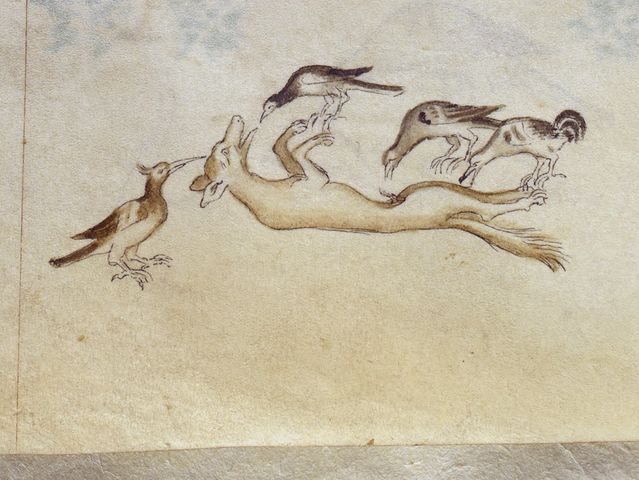
It is an astute, swindling creature. In the event that it is ravenous and can't discover anything to eat, it comes in red earth, so it appears as though it spotted with blood, and lies on the ground holding its broadness, so it is not really relaxing. The flying creatures see that it is not breathing, and is lying there spotted with blood with its tongue hanging out, and think it dead. They fly down to roost on it, and it seizes them and eats up them. 

8.Salamanders 

The lizard is alleged in light of the fact that it is evidence against flame; it is the most noxious of every toxic animal. Others kill each one in turn; this animal executes a few on the double. For on the off chance that it slithers into a tree, every one of the apples are contaminated with its toxic substance, and the individuals who eat them kick the bucket. Similarly, in the event that it falls in a well, the water will harm the individuals who drink it. It is the adversary of flame and alone among creatures can put out blazes. It lives amidst blazes without agony and without being devoured; does it not smolder, as well as it puts out the flares. 

9.Wolves 

The wolf is a covetous mammoth, and yearns for blood ... in the event that it needs to chase it prey by night, it sneaks up to the sheepfold like a faltering pooch, and, so that the mutts don't get its aroma and wake the shepherds, it goes upwind. What's more, if a twig breaks under its foot and makes a commotion, it rebuffs that foot by gnawing it. Its eyes sparkle in the night like lights; its inclination is with the end goal that on the off chance that it sees a man before the man gets a quick look at it, it can deny him of his voice, and it will then fail to acknowledge on the grounds that it has won this triumph over his voice. 

10.Panthers 

When he has eaten and is full, he covers up in his den and dozes. Following three days he rouses himself from rest, and lets forward an awesome thunder; and out of his mouth comes a sweet odor that appears to contain each sort of aroma. At the point when alternate creatures hear his voice they assemble from far and close, and tail him wherever he goes because of the sweetness of his breath. Just the winged serpent, hearing his voice, stows away in dread in the insides of the earth. There it lies in a trance, since it can't hold up under the sweet odor, and stays unmoving, as though it were dead.

Medieval Pet Names

0

Posted by EconomyLand | Posted in , , | Posted on 05:20:00

Individuals in the Middle Ages kept pets – puppies, felines, winged creatures, monkeys and numerous different sorts of creatures. In spite of the fact that they regularly had specific obligations – i.e. chasing or getting rats – there are many records that demonstrated warmth and love between these pets and their proprietors. 

Scattered in different messages and stays from the Middle Ages, and the examination by Kathleen Walker-Meikle has revealed a few cases of medieval pet names: 

Medieval Dog Names 

In England we discover pooches that were named Sturdy, Whitefoot, Hardy, Jakke, Bo and Terri. Anne Boleyn, one of the spouses of King Henry VIII, had a canine named Purkoy, who got its name from the French "pourquoi" on the grounds that it was exceptionally curious. 

Geoffrey Chaucer's The Nun's Priest Tale has a line where they name three pooches: Colle, Talbot and Gerland. In the interim, in the mid fifteenth-century, Edward, Duke of York, composed The Master of Game, which discloses how mutts are to be utilized as a part of chasing and dealt with. He additionally incorporated a rundown of 1100 names that he thought would be proper for chasing canines. They incorporate Troy, Nosewise, Amiable, Nameles, Clenche, Bragge, Ringwood and Holdfast. 

In the interim, in Switzerland a rundown of 80 canines that partook in a shooting celebration in the year 1504 has been safeguarded. They uncover the most famous name was Furst (Prince). Different names included Venus, Fortuna, and Turgk. A few pooches got their names from the work being finished by their proprietors: Hemmerli (Little Hammer) had a place with a locksmith, while Speichli (Little Spoke) had a place with a wagoner. 

The fourteenth century French knight Jehan de Seure had a dog named Parceval, while his significant other had Dyamant. Leon Battista Alberti, the Renaissance savant, said his pooch was sired by Megastomo (Big Mouth). Ludovico III Gonzaga, leader of the city of Mantua from 1444 to 1478, has no less than two mutts – Rubino and Bellina. At the point when Rubino passed on, Ludovico requested that he covered in a coffin and that he would ensure that the creature would likewise get a headstone. Isabella d'Este, a renowned Italian woman and furthermore a leader of Mantua, was known to have numerous little canines, two of which were named Aura and Mamia. 

You can take in more Pets in the Middle Ages from Kathleen Walker-Meikle's book Medieval Pets, distributed by Boydell and Brewer – Click here to peruse a meeting with Professor Walker-Meikle 

There is additionally the account of Guinefort, the holy person pooch – in the thirteenth century Stephen de Bourbon clarifies that the laborers close to the French city of Lyons were stating petitions at the grave of a puppy named Guinefort and revealing that he was doing supernatural occurrences, particularly for newborn children. He asked with the workers and educated this story: 

There was a sure château whose ruler had an infant child from his better half. In any case, when the master and woman and the medical caretaker too had gone out, allowing the tyke to sit unbothered in his support, a vast snake went into the house and made for the tyke's support. The greyhound, who had stayed there, saw this, dashed quickly under the support in interest, thumping it over, and assaulted the snake with its teeth and noting nibble with chomp. At last the canine slaughtered it and discarded it a long way from the kid's support which he cleared out all bloodied just like his mouth and head, with the snake's blood, and remained there by the support all beaten about by the snake. At the point when the medical attendant returned and saw this, she thought the tyke had been slaughtered and eaten by the pooch thus gave out an all-powerful shout. The youngster's mom heard this, hurried in, saw and thought the same and she excessively shouted. At that point the knight likewise once he arrived trusted the same, and drawing his sword murdered the canine. At exactly that point did they approach the kid and discover him unharmed, resting sweetly truth be told. On further examination, they found the snake torn up by the pooch's nibbles and dead. Since they had taken in the reality of the situation, they were humiliated that they had so treacherously murdered a canine so helpful to them and tossed his body into a well before the mansion entryway, and putting over it a vast pile of stones they planted trees adjacent as a commemoration of the deed. 


Medieval Cat Names 

In medieval England residential felines were known as Gyb – the short type of Gilbert – and that name was likewise well known for individual pet felines. In the mean time in France they were called Tibers or Tibert was bland name fo local feline in France – Tibert the Cat was one of the characters in the Reynard the Fox creature tales. 

Different names for felines included Mite, who slinked around Beaulieu Abbey in the thirteenth century, and Belaud, a dim feline having a place with Joachim du Bellay in the sixteenth century. Isabella d'Este likewise possessed a feline named Martino. Old Irish legitimate writings allude to a few individual felines and names them: Meone (little whimper); Cruibne (little paws); Breone (little fire, maybe an orange feline), and Glas nenta (annoy dark). An Irish ballad from the ninth century depicts how a friar possessed a feline named Pangur Bán, which signified 'more full white'. The ballad starts: 

I and Pangur Bán, my feline 

'Tis a like errand we are at; 

Chasing mice is his enjoyment 

Chasing words I sit throughout the night.